This week our blog from Crime Cymru’s Derek Webb moves away from our customary crimes of murder, to a well known character who deals in theft

The many appearances of The Invisible Man
The Invisible Man by H G Wells which was first published in 1897 is, in many ways, a very contemporary novel. The main protagonist, Griffin, is a scientist who invents a potion that renders him invisible. Not only does this give him the ability to play tricks on people but also he can steal with impunity. Starting in a small way, stealing money from the local vicar he soon progresses to stealing from shops and banks, justifying this to himself saying that he is not ‘stealing’ but ’liberating’ money from faceless bankers who for too long have stolen money from ordinary people. A thought which perhaps strikes a chord today. But the power that this gives Griffin soon becomes something far more sinister: his invisibility makes him feel invulnerable. He rapidly becomes megalomaniacal declaring himself to be the first ruler in the epoch of The Invisible Man and anyone who dares to oppose him will die. As such he intends to terrorise the nation until he meets his timely end.
The book came out of copyright in 2016 and I took the opportunity to adapt it for the stage, sensing that it could make an involving, interesting comedy. The novel has been adapted several times for film and radio but rarely for the stage, and knowing an actor who was also a magician, it seemed an excellent time to do it.
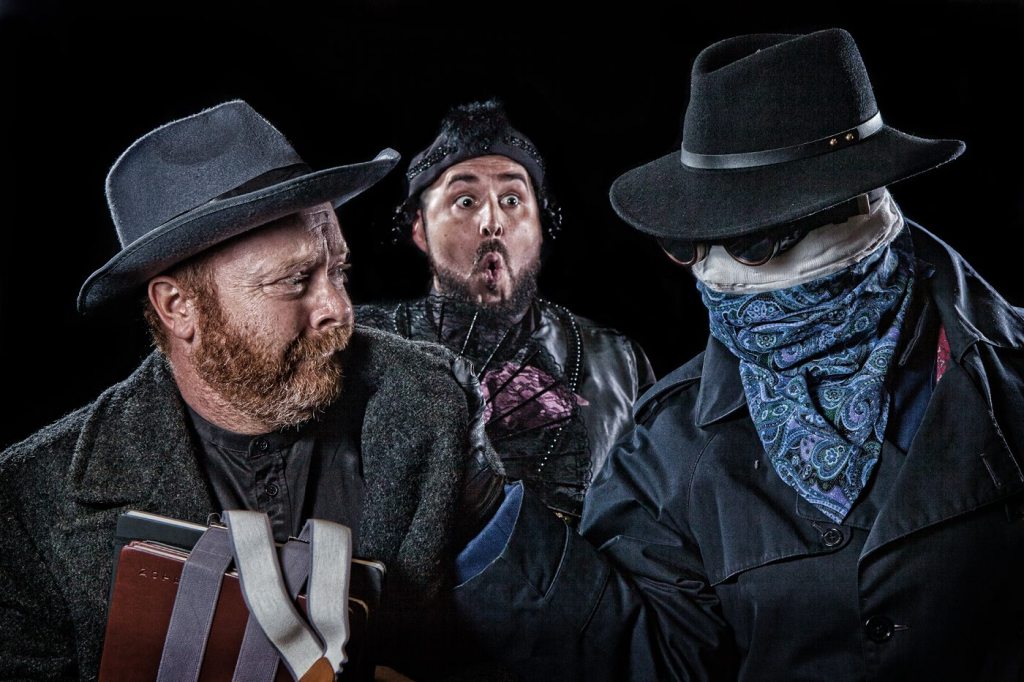
My adaptation has all parts from a vicar, to pub landlady to tramp to the Invisible Man himself – fifteen characters in total – played by just three actors. and that, in itself, is the source of a great deal of fun. It is obvious that they are aware of their quick-changing roles – and the audience is let in on the joke too – which gives rise to some very funny moments. The thought of invisibility also gives rise to plenty of visual gags with characters – and audience – being invited to imagine objects that patently aren’t visible. But, while injecting a great deal of humour, the adaptation keeps broadly with the plot of the original book and retains some key points that Wells makes; highlighting some of the economic and political problems that preoccupied him throughout his career.
The result was a short professional tour of South Wales which led to a two week run at London’s Jack Studio and earned four and five star reviews. And then, this year, Our Star Theatre Company, a professional theatre company based in Herefordshire took on the play for a 30+ performance professional tour beginning with a week long run at the Edinburgh Fringe Festival. While I wrote the play to be performed by three male actors, from Landlady to the Invisible Man, Our Star with gender blind casting, users a cast of two female actors and one male, which I believe gives the play a refreshingly different look.
The tour itself took in theatres up and down the West of England from Ledbury, Gloucester and Bristol down to Honiton in Devon. There was also one night in Barmouth and, spookily, on exactly the same night, the local amateur theatre company in Llanfairfechan performed it. Not one, but two Invisible Men appearing at the same time – who would believe it?


You can read more about Derek on this link
 Crime Cymru