Should I stay or should I go? An outtake – Chris Lloyd
What to keep and what to cut? That is the question.
When I wrote The Unwanted Dead, the first in the Eddie Giral series, I had to make savage cuts to my first (and second) draft to get the word count down to a number that wouldn’t give my editor a nosebleed. Whole scenes – and, I’ve just been reminded, characters – had to go in a purge of wasteful words. That’s fine. The first draft is always a bit gabby and needs taking down a peg or two. But having to cut so much raised a few questions that have to be tackled to make sure you don’t end up throwing the baby out with the bath water. Or simply killing the feel of the story you’re telling.

Have a quick read of the first draft of a scene from The Unwanted Dead, then come back to me afterwards for a spot of explanation and reflection. This scene takes place in a jazz bar in Montmartre in 1925, where Eddie worked on the door protecting the musicians and banging the heads of rowdy music-lovers.
# # #
I wore a roll-neck sweater to the jazz club the next night. It was too hot and it itched like hell, but it covered up the bandaging over the scar. To relieve the pain, I took some powders and a whisky and scowled at anyone who annoyed me. Legros’ words still rankled. The one time I’d shown humanity, I was censured for my lack of it. Or loss of it, I realised with a start. I’d had it once, but the fear of the trenches and the attrition of police work had put a lid on it. A lid on which more nails were banged in every day, no matter how much I would have wanted to prise it loose.
‘So why do they call you Eddie?’ the singer asked me, shaking me from my world. Her face was so close to mine, I could smell her lipstick. For a brief moment, I imagined the feel of her mouth on mine.
‘The American musicians. They reckon Édouard’s too much of a mouthful, so they call me Eddie. Now most people do. Except my wife.’ I regretted my last utterance the moment I said it. And I felt immediately ashamed at my regret. I had some humanity left.
‘You have a wife.’ She shrugged. ‘But then I have a husband. And a kid.’ She smiled at me and walked off, turning to face me as she left. ‘But don’t worry, I’m not the jealous type. My name’s Dominique, by the way, since you won’t ask.’
I watched her leave to get ready to sing. Her words rattled around my head, making whatever sense I wanted them to make. Before she went on stage, one of the Americans sang, his voice a stream of gold washing over silver pebbles, his drumming strangely soothing. The room for once was mesmerised into silence. He finished but was unable to come off stage because of the applause.
‘Play it again, Dooley,’ one of the other musicians shouted, and he went into an improvised encore.
At a table near the stage, an American couple rocked along in comradely drunkenness. Writers without a sou to their name, they’d bummed enough drinks off the people around them to get plastered, but they were in a minority tonight. None of the usual writers and artists were in. Instead, it was a raucous crowd, soothed briefly by Dooley’s playing, but now noisy as Dominique tried to make her song heard over the hubbub.
# # #
In the final draft, the first paragraph was cut drastically to make it much tighter. I also had to drop the reference to Legros. He was Eddie’s boss in the police in 1925 and a fun character to write. I’d completely forgotten about him until I stumbled across this passage, but I remember the soul-searching when I realised I had to drop him. In many ways, I’m sorry he had to go, but there just wasn’t the room for him. Now, though, I’m tempted to bring him back in another book…
What I really wanted to talk about was Dooley’s drum solo. The film buffs among you will no doubt have already got the Casablanca reference. The Sam character in the film was played by Dooley Wilson. In the draft, a musician shouts ‘Play it again, Dooley’ in my homage to the ‘Play it again, Sam’ line, which is never actually uttered in the film.
Now, the next time you watch Casablanca – because there will be a next time – take a look at Dooley’s hands when he plays the piano. He just bounces them up and down in some vague sort of time. That’s because he wasn’t playing the piano. Dooley Wilson wasn’t a pianist, but a drummer. He also played in the jazz bars of Paris and London in the 1920s, so it’s conceivable that Eddie might have met him. I also simply fancied the idea of Eddie and Dooley’s paths crossing, and of portraying Dooley Wilson as the drummer he was.
But then it came to having to cut words, and I remembered the golden rule. If a scene doesn’t further the story or give some insight into character, then it has to go. My thoughts at the time were that I was being self-indulgent by including this meeting between Eddie and Dooley. The same goes for the writers – they were Scott and Zelda Fitzgerald, even though I don’t name them – so they had to go too.
The problem with all that – and I do agree that a scene has to justify its existence – is that there are times when a scene has to be allowed to be there simply because of its curiosity value. I know that ‘Play it again, Dooley’ didn’t advance the story or tell the reader anything more of Eddie’s character, but it was curious. It was a moment that might have happened in some universe. A parenthesis, even, in the story. And I still regret having had to cut it.
I have a similar dilemma in the latest book that I’ve just sent to my editor. It involves a scene with Jacques Tati in a night club in 1941 and I just want to keep it. You have to be allowed sometimes to have that scene that doesn’t obey the golden rule. It’s just there because it’s interesting. Will my editor see it the same way? Or will I still see it the same way in the next draft? You’ll just have to wait until the next Eddie book is published to find that one out.
Biog:
After graduating in Spanish and French, Chris Lloyd lived in Catalonia, working as a teacher, travel writer, in educational publishing and as a Catalan and Spanish translator.
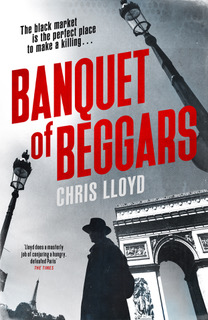
He writes the Eddie Giral series, about a French police detective in Occupied Paris. The first in the series, The Unwanted Dead, won the HWA Gold Crown for best historical novel of the year, was shortlisted for the CWA Historical Dagger and was Waterstone’s Welsh Book of the Month. The second, Paris Requiem, was a Sunday Times Best Historical Fiction Book of 2023. Third in the series, Banquet of Beggars, has been shortlisted for this year’s CWA Historical Dagger.
Links:
Buy the Eddie Giral series: https://www.orionbooks.co.uk/contributor/chris-lloyd/
The Unwanted Dead: https://www.waterstones.com/book/the-unwanted-dead/chris-lloyd/9781409190271
Paris Requiem: https://www.waterstones.com/book/paris-requiem/chris-lloyd/9781409190325
Banquet of Beggars: https://www.waterstones.com/book/banquet-of-beggars/chris-lloyd/9781409190370
Website: https://chrislloydauthor.com
Facebook: https://www.facebook.com/chrislloydbcn
Instagram: https://www.instagram.com/chrislloydauthor/
Hashtags: #TheUnwantedDead #ParisRequiem #BanquetOfBeggars #EddieGiral #OccupationSeries #Paris #Orion
 Crime Cymru