How I Write: Graham Miller
Originally I was going to write this blog post about my writing process. But then I realised that the way I write is closely tied up with my neurodiversity and so this will be a kind of rambling discussion of neurodiversity and writing and how one impacts upon the other for me.
I’m officially diagnosed as autistic but the more I investigate the whole subject, the clearer it becomes that I received a big helping of ADHD traits to go with it. (I must apologise to the organiser of these blog posts who had to remind me and then cope with this post being days late anyway!).
The way I write is chaotic. I’m not convinced by the distinction between discovery (or pantser) writers and planners. Personally I believe that it’s just a matter of scale. I tend to plot out a sequence of scenes and the order they happen in to tell a good story. So each scene might be described by a sentence or even a sentence fragment, for example “body find” or “interview the witness”. I’ll then take that prompt and spin it up into a scene that is around two thousand words. Other writers might make up the whole book on the spot, as they write their way through it. Others draw up detailed plans before even typing a word.
Given what I’ve said about my combination of autism and ADHD, it’s no surprise that I tend to have a mixture of both. Sometimes my need for order wins the day and I plot, or if it’s written, I move scenes around so that it makes sense. At other times my need for novelty wins and I just grab a scene that appeals and write that, irrespective of where it occurs in the overall scheme of the novel. In general I write the ending when I’m about a third of the way through the word count for the whole novel.
I do this because I believe in any novel there are two important parts that are critical to success. The opening chapters because they set up the plot, introduce the characters (or let you know what’s changed in a series) and the ending. Obviously you can’t get away with a saggy middle, but you need to hook the reader in to read this book and give them a satisfying ending so they read the next. What plotting I do usually involves thinking about the ending, then creating the villain and the steps to bring hero and villain together in that ending. Then I can work out what needs to happen in the beginning to lay the first breadcrumbs on the trail.
People sometimes ask me what I’m interested in and the answer is usually “everything”. I think this aspect of my neurotype really helps my writing. I can read something or watch something on TV and it’ll pique my interest. And then I’ll go on a deep dive and do some research. I won’t always start with an idea and think, “oh, that’ll make a good plot” but at some point in the research it’ll have its use and find its way into a book.
I particularly like watching cozy mysteries on television, things like Midsomer Murders. I think what gives that series its enduring popularity is that every episode is set in a different area of interest. Just from memory I can recall episodes set in a bicycle race, around bee keeping, artisan baking and in an RAF base. I try to emulate this structure and pick up on interesting details for my characters to give them a bit more depth and interests outside being either detectives or witnesses or whatever role they may have in the book.
Of course, it’s not always an advantage being neurodivergent. I am self-published so in essence I’m running my own small business and it probably suffers from my lack of organisation. As an aside, it’s not something I ever regret. From talking to other authors who have traditional publishing deals, it seems they also have to do a lot of marketing work so I don’t think it adds to my workload too much. I do have to accept that I’ll never attain the approach advocated by Stephen King where he wakes up and writes 2,000 words every day. It’s simply not the way my brain is wired. I’ll be forever having days off where my brain is churning over characters and ideas followed by days of intensity where I’ll be writing everything I’ve been thinking about.
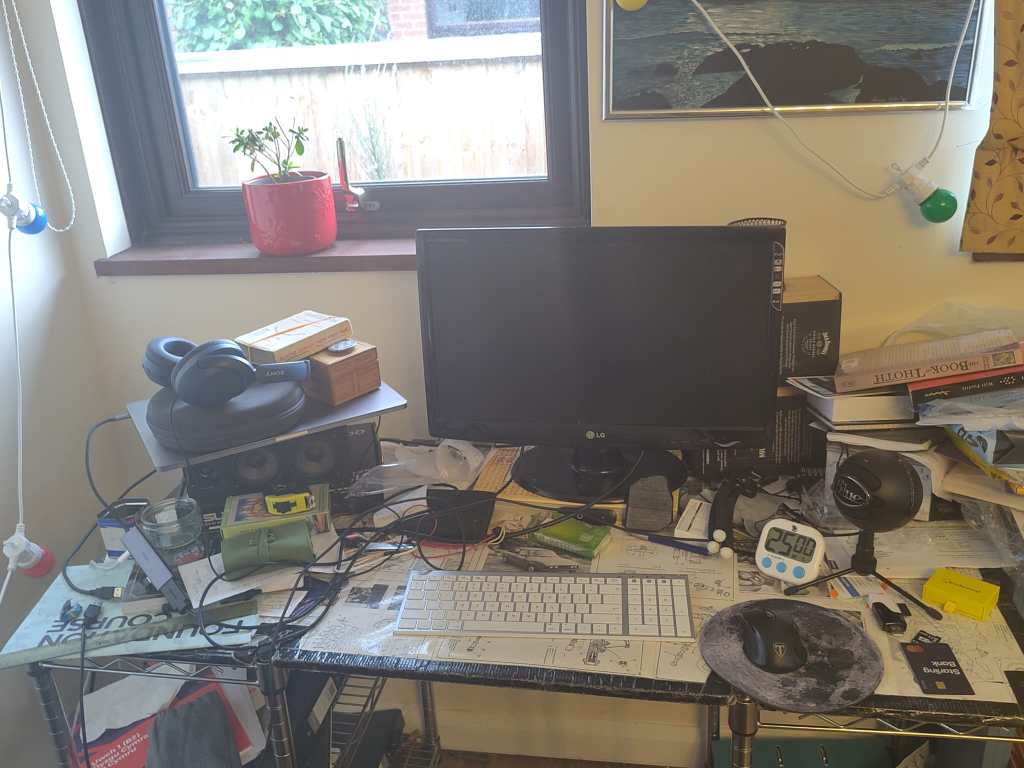
I’ll leave you with this image, which should probably come with a warning for those of you who are of a more neat and tidy disposition. This is my desk where I work. Despite its appearance, this is where I’m happy and where all my books get written!
All my links are at https://grahamhmiller.com
My Amazon author page is also here https://www.amazon.co.uk/stores/Graham-H.-Miller/author/B072X9NPG3
 Crime Cymru